These AI Class 10 Notes Chapter 1 Introduction to AI Class 10 Notes simplify complex AI concepts for easy understanding.
Class 10 Introduction to AI Notes
Understanding Intelligence Class 10 Notes
Intelligence, in a broader sense, refers to the capacity of an individual or entity to acquire, understand, apply knowledge, and adapt effectively to the surrounding environment.
Intelligence can be of a quality of anyonehumans, animals, birds and even machines, now-a-days.
One widely recognized definition comes from the American Psychological Association (APA), which describes intelligence as the ability to perceive, learn, remember, reason, solve problems, and adapt effectively to the environment.
“The measure of intelligence is the ability to change.”
Albert Einstein
Features of Intelligence
Intelligence is a multidimensional trait, and researchers have identified several features that contribute to this complex phenomenon. Here are some key features associated with intelligence:
- The ability to retain and recall information.
- Logical thinking and the capacity to solve problems.
- Understanding and interpreting information.
- The capability to adjust and learn from new experiences.
- Generating novel ideas and solutions.
- A strong command of language for effective communication.
- The ability to understand and interact with others.
- Recognizing and understanding the emotions of others and oneself as well.
- Making sound decisions based on available information and making reasoned judgments.
- Having a personal drive and curiosity to learn and achieve.
- Navigating social situations effectively.
- Recognizing and interpreting social signals.
- Applying knowledge and skills in practical and real-world situations.

Role of Intelligence in Our Lives
Intelligence plays a pivotal role in shaping and enhancing various aspects of our lives. Here are some points suggesting the role of intelligence in our lives:
Education Intelligence is crucial in acquiring knowledge and skills, influencing academic success and career development.
Problem-solving Intelligent reasoning and analysis are essential for addressing complex challenges in professions such as medicine, engineering, business etc.
Emotional Intelligence This aspect of intelligence impacts social interactions, fostering effective communication, understanding of others, and emotional self-regulation.
Decision-making Intelligence guides individuals in making informed choices, from financial decisions to health-related matters, contributing to overall well-being.
Adaptability Intelligent individuals can adapt to changing circumstances, enhancing resilience and the ability to thrive in diverse environments.
Personal Growth Intelligence plays a key role in personal development, influencing continuous learning, self-improvement, and a deeper understanding of the world.
Societal Progress Collectively, intelligent individuals contribute to societal advancement through innovation, collaboration, and the ability to address global challenges.
Types of Intelligence Class 10 Notes
Based on the abilities and skills, intelligence is divided into different types those describe below
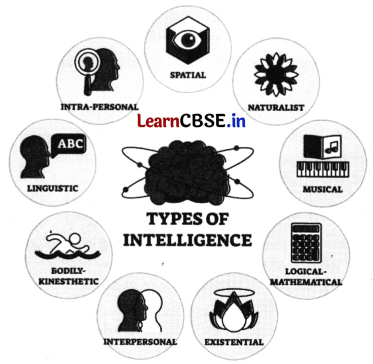
Linguistic Intelligence It is the ability to use language to express oneself rhetorically or poetically. People with linguistic intelligence often excel in writing, speaking and language.
Logical Mathematical Intelligence It involves the ability to use logic, reasoning, carry out mathematical operations and critical thinking to solve problems. People with this intelligence are good at logical thinking and mathematical operations.
Spatial Intelligence It is the ability to consider things in 3D, to transform, modify or manipulate visual information. People with this intelligence are good at visualization sense of direction, puzzle building and reading maps.
Musical Intelligence It is the ability to perceive, discriminate, create and express musical forms. People with this intelligence are good at thinking in patterns, rhythms and sounds.
Bodily kinesthetic Intelligence It is the ability to use one’s body effectively and to manipulate objects skillfully. People with this intelligence often excel in Physical activities such as sports, dance, crafts etc.
Interpersonal Intelligence It is the ability to understand the intentions, motivations and desires of other people and consequently to work effectively with others. People with this intelligence are good at understanding and interacting with other people.
Intrapersonal Intelligence It is the ability to understand oneself, to have an effective working model of oneself, including one’s desires, fears and capacities. People with this intelligence are good at understanding of their own emotions, motivations and goals.
Naturalist Intelligence It involves sensitivity to and understanding of the natural world, including plants, animals and natural phenomena. People with this intelligence are expert in recognising and classifying the numerous species, the flora and fauna.
Existential Intelligence It is the ability to immerse into deeper questions about life and existence, such as meaning of life, the nature of death etc. People with this intelligence are good to see situations from an outside perspective.
All humans have all nine of these intelligences only at different levels. One might be an expert at painting, while the other might be an expert in mathematical calculations. One is a musician, the other is an expert dancer.
In other words, we may define intelligence as
Ability to interact with the real world
To perceive, understand and act
- Speech Recognition-Understanding and synthesis
- Image Recognition
- Ability to take action: to have an effect
Reasoning and planning
Modelling the external world, given input
- Solving new problems, planning and making decisions
- Ability to deal with unexpected problems, uncertainties
Learning and adaptation
Continuous learning and adapting graph
- Our internal models are always being updated
- Learning to categorize and recognise
Decision Making Class 10 Notes
Decision making is the process of selecting a course of action among several alternatives to achieve a desired outcome or goal.
The decision making process typically involves several steps :
Step 1 Identify the situation
Try to clearly define the nature of the decision you must make based on any situation.
Step 2 Gather relevant information
Collect some proper information before you make your decision. Some information is internal: you’ll seek it through a process of self-assessment. Other information is external: you’ll find it online, in books or from other sources.
Step 3 Identify the alternatives
Once you collect information, you will probably identify several possible paths of action, or alternatives. In this step, you will list all possible and desirable alternatives.
Step 4 Assess the evidence
Estimate the outcomes of each alternative whether they can given the desired result. Finally, place the alternatives in a priority order, based upon your own value system.
Step 5 Select among alternatives
Once you have assessed all the evidence, you are ready to select the alternative that seems to be best one for you. You may even choose a combination of alternatives.
Step 6 Take an action
You’re now ready to take some positive action by beginning to implement the alternative you chose in Step 5.
Step 7 Review your decision & its consequences
In this final step, evaluate whether or not it has resolved the need you identified in Step 1.
If the decision has not met the identified need, you may want to repeat certain steps of the process to make a new decision.
Role of Intelligence in Decision Making
Here’s a breakdown of how intelligence impacts decision making:
- Intelligence enables individuals to comprehend and analyze complex information effectively.
- Intelligent individuals can identify problems, break them down into manageable components, and generate creative solutions.
- Intelligence enables individuals to anticipate the potential consequences of their actions and make predictions about future outcomes.
- Intelligent individuals can draw upon their knowledge and expertise to inform their decision-making process, avoid repeating mistakes.
- Intelligent individuals can regulate their emotions, maintain composure under pressure, and make decisions with clarity and objectivity.
What is Al? Class 10 Notes
When a machine possesses the ability to mimic human traits, i.e., make decisions, learn and improve on its own, it is said to have Artificial Intelligence (AI).
In other words, you can say that a machine is artificially intelligent when it can accomplish tasks by itself collect data, understand it, analyse it, learn from it, and improve it.
How do Machines become Intelligent?
Machines become intelligent with the algorithms that are fed into them by developers. They are trained with information that makes them intelligent to active the desired output. An intelligent machine has the ability to monitor its environment and then adjust its actions based on what it senses. If you see around yourself, you will find many such machines that use AI.
In simpler terms, we can summarize as follows :

Where data is the information needed for training artificial intelligence systems and algorithms are needed to analyse data which will help in making predictions.
WHAT IS NOT AI?
Everything that is automatic is not always AI. There’s a thin line that divides the technology that uses AI or not.
Here are few examples that are not AI as they do not thinks on their own but are simply acting upon the set of instructions:
A fully automatic washing machine can work on its own, but it requires human intervention to select the parameters of washing and to do the necessary preparation for it to function correctly before each wash. So, it is an example of automation, not AI.

An air conditioner can be operated remotely with the help of internet but still needs a human touch. This is an example of Internet of Things (IoT).

We also get to see a lot of projects which can automate our surroundings with the help of sensors. Since the bot or the automation machine is not trained with any data, it does not count as AI.

We can also say that not all the devices which are “smart” in works are AI-enabled. For example, a TV does not become AI-enabled if it is a smart one.

Applications of AI Around Us Class 10 Notes
There are numerous benefits when using AI daily; you may use it without awareness.
1. Search Engine Algorithms Complex frameworks known as search engine algorithms are used to provide users with timely, relevant, and helpful information. They efficiently search the web and produce results in a matter of seconds by combining crawling, indexing, and ranking processes.

2. Digital assistants Digital assistants like Siri, Google Home, and Alexa are designed to understand voice commands using AI-powered Voice User Interfaces (VUI).

3. Food ordering sites By analysing user preferences and ordering history, AI algorithms can suggest relevant menu items, creating a tailored experience for each customer

4. Music and media streaming services Streaming apps like Netflix, Spotify, and Hulu use artificial intelligence to personalize their recommendations for each user.

5. Banking Banks, insurance companies, and other financial service providers increasingly use AI technology to improve operations. AI can assist with tasks like managing investments, processing financial transactions, and providing better customer service.

6. Credit and fraud With millions of transactions happening every day, it’s tough for a person to keep track of them all and. identify any fraudulent activity. But with the help of AI and machine learning algorithms, thousands of transactions can be processed in seconds, and the software can be trained to detect potentially fraudulent activities, making it easier to prevent future problems.
7. Chatbots Interacting with customers can be time-consuming and stressful. Chatbots are taught to communicate with the coustomers using Natural Language Processing (NLP) ensuring maximum customer satisfaction.
8. Navigation and travel Navigation apps like Google Maps and Waze rely on large amounts of geographical data to provide users with accurate and up-to-date information using imaging algorithms can quickly and accurately tag road features and update digital maps in real time.

9. E-mail system In today’s digital age, emails have become a fundamental aspect of our personal and professional lives. Artificial intelligence has played a vital role in improving our email experience, to providing intelligent suggestions for our replies.

10. Video games Gamers can now experience more exciting and engaging gameplay thanks to AI-powered innovations in the gaming industry.

11. Security and surveillance AI-powered video monitoring software can help to detect unusual behaviour and pick up on incidents that might be missed by human surveillance.

12. Internet of Things The combination of AI and IoT is changing how we interact with our homes. With the advent of smart home technology, we can now control many aspects of our living spaces with the help of connected devices.
Basics of AI Class 10 Notes
The term artificial intelligence was coined in 1956 by John McCarthy. John McCarthy is one of the “founding fathers” of artificial intelligence, together with Alan Turing, Marvin Minsky, Allen Newell, and Herbert A. Simon.
Definitions of AI
Here are some definitions that provide a range of perspectives on what artificial intelligence is and how it’s understood across different organizations and sources.
NITI Aayog
AI refers to the ability of machines to perform cognitive tasks like thinking, perceiving, learning, problem solving and decision making.
Initially conceived as a technology that could mimic human intelligence, AI has evolved in ways that far exceed its original conception.
World Economic Forum
Artificial intelligence (AI) is the software engine that drives the Fourth Industrial Revolution.
It holds the promise of solving some of the most pressing issues facing society, but also presents challenges such as inscrutable “black box” algorithms, unethical use of data and potential job displacement.
European Artificial Intelligence (AI) Leadership
AI is not a well-defined technology and no universally agreed definition exists. It is rather a cover term for techniques associated with data analysis and pattern recognition.
Encyclopedia Britannica
AI is the ability of a digital computer or computer-controlled robot to perform tasks commonly associated with intelligent beings.
AI, ML and DL Class 10 Notes
In this new age of technology, everyone wants to incorporate Artificial Intelligence (AI), Machine Learning (ML) and Deep Learning (DL) in day-to-day life to achieve ease of working. Most of the times, these are interchangeably used but it is important to understand that artificial intelligence is the under which all these other terms are.
These tecbnologies have wide range of applications in various sectors such as banking, finance, manufacturing, healthcare, education, business, information technology, retail etc.

Machine Learning (ML)
Machine Learning is a subset of Artificial Intelligence that focuses on teaching computers to learn and improve from experience without being explicitly programmed. Instead of following fixed instructions, machine learning algorithms use data to recognize patterns and make decisions.
Machine Learning is widely applied in various fields, including recommendation systems, image and speech recognition, and predictive analytics, enhancing the capabilities of computer systems to handle complex tasks.
Deep Learning (DL)
It enables software to train itself to perform tasks with vast amounts of data. In Deep Learning, the machine is trained with huge amounts of data which helps it in training itself around the data. Such machines are intelligent enough to develop algorithms for themselves.
Deep Learning is the most advanced form of Artificial Intelligence out of these three.
Domains of AI Class 10 Notes
Artificial Intelligence becomes intelligent according to the training which it gets. For training, the machine is fed with datasets. According to the applications for which the AI algorithm is being developed, the data which is fed into it changes.
As you can see, Artificial Intelligence is a vast domain. Everyone looks at AI in a different way according to their mindset. Now, according to your knowledge of AI, start filling the KWLH chart:
K What I Know?
W What I Want to know?
L. What have I Learned?
H How I learnt this?
With respect to the type of data fed in the AI model, AI models can be broadly categorised into three domains:
- Data Science
- Natural Language Processing
- Computer Vision
Data Science
Data sciences is a domain of AI related to data systems and processes, in which the system collects numerous data, maintains data sets and derives meaning/sense out of them. The information extracted through data science can be used to make a decision about it.
Example of Data Science
Reproductive Health Monitoring Apps like Clue harness the capabilities of data science to provide women with insights into their menstrual cycles and reproductive health.
By analyzing diverse metrics, including mood and physical symptoms, these platforms offer personalized predictions and alerts, empowering individuals to make informed decisions about their health.

Natural Language Processing (NLP)
Natural Language Processing (NLP) is a field of artificial intelligence that focuses on enabling computers to understand, interpret, and generate human language. NLP involves the interaction between computers and human language in the form of text or speech. The ultimate goal of NLP is to bridge the gap between human communication and computer understanding.
Example of Natural Lapguage Processing
Smart Assistants These smart assistants, such as Siri or Alexa, use voice recognition to understand our everyday queries, they then use natural language generation (a subfield of NLP) to answer these queries.

Computer Vision
Computer Vision is a field of artificial intelligence that enables computers to interpret and understand visual information from the world, primarily through images and videos. It involves developing algorithms and models that allow machines to process, analyze, and make decisions based on visual data.
Example of Computer Vision
Object Detection and Tracking It’s used in surveillance systems to detect and track objects such as cars and people. Object detection and tracking technology can also be used in retail stores to track customers and analyze their behavior.
This technology works by using cameras to capture images of objects and then using algorithms to analyze the images and identify the objects.

AI Ethics Class 10 Notes
Ethics in AI is crucial because artificial intelligence technologies increasingly influence and shape various aspects of human life, from healthcare and education to employment and privacy.
By prioritizing ethics in AI development, we ensure that these technologies are designed and deployed to benefit humanity, uphold fundamental rights, and minimize potential harms.
For example Imagine a self-driving car navigating a busy street when a sudden obstacle appears-a group of pedestrians crossing the road against the traffic signal. The car has two options: either diverge to avoid the pedestrians, potentially putting the car occupants at risk, or maintain its course, risking harm to the pedestrians.
With the help of this example, we need to understand that the developer of the car goes through all such dilemmas while developing the car’s algorithm.
Data Privacy Class 10 Notes
Artificial intelligence is all about data. Without data, AI is nothing. Data plays a vital role in AI.
Data privacy in AI is a critical consideration due to the significant amount of data involved and the potential risks associated with misuse or unauthorized access to personal or sensitive information.
For example If you search on Google for course and their description, just after the search, all the apps on your phone which support advertisements, will start sending messages about course fee, details etc that you can enroll for those courses.
Remember whenever you download an app and install it, it asks you for several permissions to access your phone’s data in different ways. Hence every now and then, the app has the permission to access various sensors which are there in your smartphone and gather data about you and your surroundings.
AI Bias Class 10 Notes
AI bias is a pressing ethical concern that arises when artificial intelligence systems exhibit preferences or prejudices that reflect the biases present in the data used to train them.
For example A multinational corporation adopts an AI-driven hiring platform to streamline its recruitment process. The platform is trained on historical hiring data, which, unknown to the company, reflects a gender bias that existed in previous hiring practices.
The AI model casually learns and memorize this bias, leading to the systematic misinterpretation of qualifications associated with female candidates. As a result, the platform consistently ranks male applicants higher, hindering the chances of qualified female candidates from progressing in the hiring process.
AI Access Class 10 Notes
Since Artificial Intelligence is still a evolving technology, not everyone has the opportunity to access it. The people who can afford AI enabled devices make the most of it while others are left at a disadvantage. Due to this, a gap has emerged between these two classes of people and it gets widened with the rapid advancement of technology.
Note Where AI is advancing and improving the lives of people by working for them. The other hand, it might leave many people with work, especially those who don’t have specific skills.
AI for Kids Class 10 Notes
AI for kids refers to educational tools, toys, games and resources that introduce children to concepts related to artificial intelligence in an age appropriate and engaging manner. These AI for kids initiatives aim to foster curiosity, critical thinking, problem-solving skills and computational thinking from an early age.
For example A young boy in class 3 has got some Maths homework to finish. Soon, he starts asking Alexa to answer all his questions. Alexa replies with answers and the boy simply writes them down in his notebook.
While this scenario seems funny, it still has some concerns related to it. While the boy is good at using technology, he is not really learning anything. He is not using his own brain to solve the math problems.
Glossary :
- Intelligence It refers to the ability to acquire and apply knowledge and skills in various domains.
- Artificial Intelligence It is technology that enables computers and machines to simulate human intelligence and problem-solving capabilities.
- Data Science It is a detailed process that mainly involves preprocessing analysis, visualization and prediction.
- Natural Language Processing it is the technology that is used by machines to understand, analyse, manipulate, and interpret human’s languages.
- Computer Vision It enables computers to Intercept and extract information from images and videos, in a manner similar to human vision.
- Ethics in Al is crucial because artificial intelligence technologies increasingly influence and shape various aspects of human life, from healthcare and education to employment and privacy.
The post Introduction to AI Class 10 Notes appeared first on Learn CBSE.
from Learn CBSE https://ift.tt/epmyWYB
via IFTTT

No comments:
Post a Comment