Include Kaushal Vikas Class 9 Solutions and Class 9 Vocational Education Chapter 11 Healthcare Notes in your preparation plan to revise efficiently.
Class 9 Kaushal Vikas Chapter 11 Notes
Tourism
- Tourism is the movement of people from one place to another to explore new places, relax, enjoy and learn about different people, cultures and ways of life.
- India is a country in which the land, language, food and stories change after every few kilometres. Each place has something unique such as culture, monuments, places of worship, landscapes, food, sports, festivals or museums.
- Some places are developed as tourist sites, while some remain less explored.
- The tourism industry helps people visit places known for their uniqueness and beauty. People travel for different reasons like rest, rejuvenation, or learning about different cultures.
- Travel enriches our lives and helps us understand people beyond our surroundings. It spreads messages of equality, diversity and compassion.
- A pleasant journey depends on the efforts of guides, drivers, artisans, photographers, hospitality staff .and volunteers.
- The Indian culture believes in ‘Atithi Devo Bhava’ which means guests are treated like gods.
The Ministry of Tourism, Government of India launched the Incredible India campaign in 2002 to encourage travellers from India and abroad to explore tourist destinations across the country.
Different Kinds of Travel Experience
A variety of experiences are available for tourists in India. Some examples are
- Community and Eco-village Stays / Homestays: Families welcome tourists into their homes and offer simple local food while sharing stories of their land in deserts, hills or farms.
- Tribal and Cultural Heritage Tourism: Tourists interact with artists, farmers and elders to learn about local culture, music, art and traditions.
- Cycling and Walking Trails: Travellers explore old towns, forts and village lanes through guided walks or cycle rides.
- River, Lake and Forest Tourism: Activities like boat rides, nature walks and birdwatching help visitors experience India’s wetlands and forests.
- Spiritual and Wellness Journeys: Pilgrimages, yoga camps and Ayurveda centres provide relaxation, healing and inner peace.
Responsible Tourism
Responsible tourism is a way of travelling that focuses on protecting the environment and respecting local communities by leaving no waste, keeping noise level low and preserving natural habitats.
Process Chart
Scoping the Work
Scoping the work involves planning different aspects of the service in a systematic manner
- Type of Service: Decide the kind of service you want to provide based on your locality. For e.g., organise a visit to a historical site, local festival, mandi, popular food street, or a place of religious importance that may attract visitors.
- Availability of Materials and Resources: Identify the materials and resources required, such as maps, photographs, digital devices (like tablets with internet access) and stationery for preparing brochures. Seek support from elders in the community who can share valuable stories and information.
- Usefulness and Relevance: Make sure the service is meaningful for the school or community for example, highlighting local heritage, helping tourists navigate or creating a local tourism map.
- Location of Service: The service can be delivered within the school, such as through exhibitions or presentations, or outside at nearby places of interest. While planning, consider safety, accessibility, distance and permissions required. The work should be simple, manageable and easy to organise.
Making the Process Chart
- A process chart lists all tasks involved in providing the tourism service in a systematic order.
- It helps organise and allocate each task clearly, preventing confusion and ensuring the service is delivered safely and on time.
- A sample process chart for a walk to a local site of interest is shown below
Process Chart for a Walk to a Local Site of Interest
| Tasks for Toursim Service | Dates | Responsibility |
| Preparatory visit to site | Week 1 | Team Leader |
| Gathering information about the site | Week 1 | Research Group |
| Developing a route map | Week 1-2 | Mapping Team |
| Preparation of promotional materials, maps, script for narration, refreshments and waste disposal arrangements | Week 2 | All Members |
| Promoting the service | Week 2-3 | Communication Team |
| Delivering the service | Day of service | All members |
| Feedback and reflection | After service | Documentation Team |

Selecting Materials
- After deciding the tourism service tasks, list all the materials required in advance.
- Choose materials based on their use, safety and availability.
- Reuse and recycle materials wherever possible to support responsible tourism.
Materials for Tourism Service
| Materials | Use | Safety Note |
| Stationery (cardboard, scissors, tape, pins) | Making posters, signages, notebooks and charts | Reuse and recycle as much as possible |
| Dustbins or disposable bags | Collecting dry and wet waste during tours or events | Place bins away from walking paths, handle waste hygienically |
| Water bottles | Ensuring hydration for students and tourists | Use clean, reusable bottles or glasses |
| Safety/First-aid kit | Providing basic first-aid items if needed | Check expiry dates on all items in the kit |
Selecting Tools
- Choose tools based on the type of tourism service being provided.
- Make sure the tools are safe, easy to use and available.
Tools Used for Tourism Services
| Tools | Use | Safety Note |
| Tablet/Smartphone | Digital mapping, taking photographs, recording audio notes or checking information online | Use responsibly, avoid use while crossing roads or in crowded areas |
| Map/GPS | Guiding tourists, planning routes and marking important locations | Verify routes in advance, do not rely only on GPS in unfamiliar areas |
| Speaker | Addressing a group during a tour or giving instructions | Keep volume low, avoid disturbing public or sacred spaces |
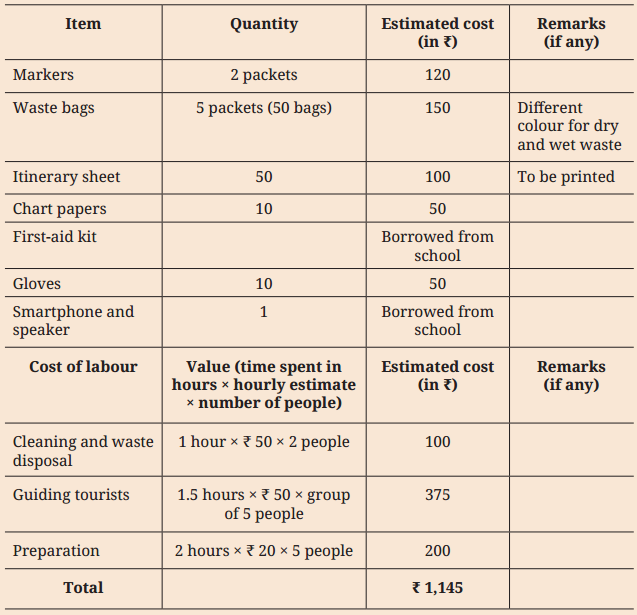
Bill of Materials (BoM)
- A Bill of Materials (BoM) lists all items needed for the service, their quantity, estimated cost and remarks.
- The BoM helps estimate total cost in advance and prevents unnecessary waste.
- Every service has a cost. Some costs are visible (chart paper, pens) and others are less visible (time spent in preparation).
- Unexpected situations like delays, cancellations or weather changes can also increase costs.
- In tourism, the duration of the tourist season is often limited to months with pleasant weather. The cost of providing services in remote areas is also higher.
Sample Bill of Materials
Consent Form
- A consent form is a clear communication of what the service provider will offer and what each person is responsible for.
- It is not a legal document, but a way to set expectations, build trust, avoid confusion and ensure safety.
- The consent form should include what will be provided, safety expectations, charges and refund policies, and consent for photos.
Points to Keep in Mind While Developing a Consent Form
- Share clearly what tourism service will be provided.
- Mention safety expectations and guidelines for the tourist.
- Clarify charges and refund policies.
- Take written consent for photographs.
Preparation for Service
- Good preparation makes your service smooth, safe and enjoyable for tourists.
- It also helps the team stay organised and reduces last-minute confusion.
- Once materials, tools, a process chart and a BoM are ready, start preparing for the actual service.
Safety Measures
- Ensure that clean food and safe drinking water are available.
- Carry a first-aid kit, umbrellas and other necessary items.
- Follow local norms, guidelines and safety instructions.
- Keep emergency contact numbers (police, helpline, fire service) handy.
- Identify the location of clean and hygienic toilets.
- Use polite and respectful language while interacting with others.
- Persons with disabilities must be accommodated; identify their needs and ensure ramps, accessible toilets and easy routes.
Preparing a Tourism Map
- A map is one of the most important tool used in tourism. It helps tourists understand a place, locate landmarks and plan their movement.
- Tourism maps highlight attractions, facilities and natural or cultural features, unlike detailed geographical maps.
- A tourism map focuses on
- Places of Interest Heritage sites, parks, temples, markets, beaches, museums, etc.
- Useful Facilities Washrooms, drinking water, parking, bus stops, eateries, etc.
- Routes and Directions Help tourists move safely and comfortably.
- Tourism maps are drawn with clear symbols, colours and labels so people from different backgrounds can easily understand them.

Making an Information Brochure
- Information about the history, stories, culture, language and cuisine of a place is important for tourists.
- Categories of information may include food, flora and fauna, dance and music, places of interest and common local terms.
- A Brochure also includes information, about toilets and drinking water points, health or first aid support, emergency numbers, lost and found point, nearby hotels or homestays and their tariff based services.
- Details about museums or theatres such as timings, weekly holidays, entry fees and parking facilities should also be included.
- Information can be collected from books, the internet, elders in the community or local guides.
- The brochure can be handmade, printed or in the form of audio-visual content (e-brochure).
- AI-based apps can be used to create informative e-brochures with headings, icons, maps and images.
- Choose suitable templates, adjust colours and fonts to make important information easy to find.
Preparing a Script
- Script should include the history of the tourist site, legends, festivals and or unique stories related to the place.
- Try to include interesting facts, questions or short narratives to make the script more engaging.
- Create your own script describing the uniqueness of the experience you have designed.
- Make sure to include operational or logistical aspects in an interesting manner, such as
- When to stop for rest.
- Local guidelines (for example, removing shoes while entering a place of worship).
- The script should be detailed with these instructions so that you are prepared for the final day.
- A mock presentation in your group or class, in the presence of a teacher or an expert, can help you assess your script.
im-3
Figure: Component of storytelling while preparing the script for tourists
Signages for Effective Communication
- Signages refer to the system of signs created to make the service efficient.
- Clear and visible signs help tourists feel comfortable and welcomed.
- Signs may indicate facilities such as toilets, drinking water, resting spots, entry/exit points and ramps.
- Depending on the service, you may:
- Prepare simple labels for exhibits, old photographs or artefacts with brief descriptions.
- Prepare signs for safe and unsafe spots.
- Prepare signs to indicate the positions of volunteers managing crowd movement.
- Prepare signs for rest points with shade and drinking water.
- Prepare signs such as ‘Do Not Touch’ or ‘Fragile’ where required.
- Prepare signs to promote ‘zero-waste’ messages.
- Article 51A(f) of the Constitution makes preserving the country’s rich heritage a fundamental duty.
- Section 30 of the Ancient Monuments and Archaeological Sites and Remains Act, 1958 punishes damage to protected monuments with up to 2 years imprisonment, a fine of lakh or both.
- The Prevention of Damage to Public Property Act, 1984 also punishes damage to public property, including heritage sites.
Promoting the Service
- Once the service is planned, promote it through appropriate channels.
- Know your target audience by understanding whether they prefer digital media, printed pamphlets or posters.
- For a small number of people, use personal invitations or printed material.
- For a large audience, digital media and social group platforms are better options.
- Your communication must be inviting and catchy to attract people.
- Methods of promotion include: posters, advertisements, short video clips, announcements and social media posts (with permission).
Delivering the Service
Pre-Tour Checklist
Create a detailed schedule of activities with timing and location details for the day of service.
Sample Itinerary of Walk Tour to the Tourist Site
| Time | Task |
| 08 : 50 a.m. | Assembly at school gate |
| 09 : 00 a.m. | Welcome and briefing on tour; registration and consent form filling |
| 09 : 30 a.m. | Start walk; one rest stop (optional) |
| 09 :55 a.m. | Reach the tourist site |
| 11: 00 a.m. | Refreshments |
| 12 : 00 p.m. | Return walk; one rest stop (optional) |
| 12 : 25 p.m. | Reach school date; fill feedback form |
Prepare a materials checklist to ensure everything required is ready before the tour begins.

Assign responsibilities clearly so every team member knows their role on the service day.
Engaging with Tourists
- While interacting with tourists, it is important to maintain a respectful, helpful and professional approach.
- Dress appropriately in neat and comfortable clothes suitable for walking, climbing steps or standing for long periods.
- Remain patient and calm, especially in situations involving large groups, heat, noise or crowding.
- Respond politely to suggestions or requests that may not be possible. Do not be rude or show irritation.
- Take special care of elders, children and persons with specific needs. Remind them of uneven ground, steps or rest points.
- Offer helpful tips before the tour such as carry an umbrella, wear sunglasses, drink water, wear comfortable shoes and keep food in bags.
- Polite but firm communication builds trust with tourists.
After the Service
- After the service is completed, collect written feedback or short audio/video comments from tourists. Feedback helps you understand what went well and how to improve in the future.
- Check all areas where the service was provided to ensure waste has been disposed of as per protocol. Clean and restore the site to its original condition after the tourists leave.
- Segregate waste into dry and wet waste and dispose of it responsibly using dustbins or designated collection points. This shows respect for the place, the local community and the environment, reflecting responsible tourism.
Basic Measures While Performing the Services
- Prepare a clear tour map in advance marking routes, entry/exit points, important locations, rest stops, water points and emergency areas. This ensures smooth tourist movement and safety.
- Careful observation during the site visit helps in understanding how to communicate effectively, sequence information and manage visitors.
- Develop signages using simple language, symbols and visuals. Clear signs help tourists navigate easily and follow safety instructions.
- Use polite communication, active listening and clear responses. Friendly interaction makes the tour informative and enjoyable. Always dress neatly and appropriately.
- Ensure all places visited remain clean. Do not allow anyone to damage or deface sites in any way
The post Healthcare Class 9 Notes Kaushal Vikas Chapter 11 appeared first on Learn CBSE.
from Learn CBSE https://ift.tt/6d3ErB0
via IFTTT

No comments:
Post a Comment