To prepare smartly, include Kaushal Bodh Class 6 Extra Questions and Class 6 Vocational Education Chapter 5 Project 3 School Museum Extra Questions MCQ in your study plan.
School Museum Class 6 Extra Questions MCQ
School Museum Class 6 Extra Questions
Question 1.
Your friend points to a plastic water bottle and says it is an artefact. Is your friend correct? Why or why not?
Answer:
No, my friend is not correct. An artefact is usually an object that is old, unique or culturally significant, showing history or traditions. A plastic water bottle is modern and common, so it does not reflect history or culture like true artefacts do.
Question 2.
if you wanted to visit a museum without leaving your home, what option would you choose?
Answer:
I can choose a virtual museum tour. Many museums, including those in India, offer online tours on their websites, where I can see exhibits, read descriptions and explore artefacts without physically visiting the museum.
Question 3.
Who would you contact if you found ancient pots and tools while digging in your backyard?
Answer:
I should contact an archaeologist. Archaeologists study ancient human societies and can carefully excavate, preserve and analyse artefacts like pots and tools to help understand their historical and cultural significance.
Question 4.
Imagine you found an old, faded letter written in a language you cannot read. Which tool could help you understand it?
Answer:
An Al tool like Google Lens, Microsoft Office Lens or Adobe Scan can help read the letter using Optical Character Recognition (OCR). To understand the language, translation tools like Google Translate or Bhashini Anuvaad can be used.
Question 5.
Why should you avoid touching old artefacts with bare hands?
Answer:
Old artefacts should not be touched with bare hands because oils, dirt and moisture from hands can damage them.
Many artefacts are fragile or made of sensitive materials, so touching can cause wear, stains or deterioration overtime.
Question 6.
What is the advantage of a virtual museum tour over a physical visit?
Answer:
The advantage of a virtual museum tour over a physical visit is that it allows exploring museums from home, saving time and travel.
It also provides access to distant or rare collections and includes interactive features and detailed information that may not be available during a physical visit.
Question 7.
Mention two objects from your home that could become artefacts for future generations.
Answer:
Two objects from home that could become artefacts for future generations are
- Old Radio Shows how people used to listen to news and music.
- Handwritten Family Recipe Book Reflects family traditions and daily life in the past.
Question 8.
If you want to create a presentation about an artefact for visitors who speak Tamil, which tool from would you use?
Answer:
If a presentation about an artefact is needed for visitors who speak Tamil, Bhashini Anuvaad can be used.
It can translate spoken or written content into Tamil, helping communicate the history and significance of the artefact clearly.
Question 9.
Why might your grandmother’s stories about an old artefact be as valuable as the artefact itself?
Answer:
Grandmother’s stories about an old artefact are as valuable as the artefact itself because they provide context, history and personal experiences related to it.
These stories explain its use, significance and cultural meaning, which cannot be understood by just looking at the object.
Question 10.
What is the purpose of placing a small card with writing next to an artefact in a museum?
Answer:
The purpose of placing a small card with writing next to an artefact in a museum is to provide visitors with information about the artefact, such as its name, history, use and significance, helping them understand and appreciate it better.
Question 11.
Explain how museums help us understand both the past and the present.
Answer:
Museums help us understand the past by preserving artefacts, manuscripts, tools and artwork that show how people lived, worked and created in earlier times. They allow us to see and study objects from ancient civilisations, helping build a picture of history.
Museums also help us understand the present by displaying modern art, technology and cultural traditions, showing how communities live today.
This connection between past and present enriches our knowledge of history and culture.

Question 12.
Describe the process of selecting five artefacts for a school museum exhibition. What three factors should be considered?
Answer:
The selection of artefacts for a school museum exhibition involves discussion, comparison and careful decision-making within a group.
First, students identify and collect different artefacts from their homes or community.
Then, they discuss each artefact and shortlist the most suitable ones. Finally, the group selects five artefacts based on specific criteria.
The three factors we should consider are as follows
- Historical or Cultural Significance: The artefact should reflect traditions, events or daily life of the past.
- Condition and Preservation: The artefact should be safe to display and not easily damaged.
- Interest and Relevance: It should engage visitors and be meaningful to students and the community.
Question 13.
How can you preserve different types of artefacts? Give examples of three different materials.
Answer:
Different types of artefacts can be preserved according to their material, for example
- Wooden Artefacts: Dust regularly with a soft brush and keep away from moisture to prevent damage.
- Brass or Metal Artefacts: Wash and polish carefully to avoid corrosion and maintain their shine.
- Cloth or Textile Artefacts: Hang carefully or store in clean, dry envelopes to prevent tearing, dust or fading.
Question 14.
What is the difference between a physical museum visit and a virtual museum tour?
Answer:
The difference between a physical museum visit and a virtual museum tour is
| Aspect | Physical Museum Visit | Virtual Museum Tour |
| Location | Requires going to the museum in person | Can be done from home using a computer or tablet |
| Interaction with artefacts | Can see artefacts directly, sometimes touch them | Can view images, videos and 3D models only |
| Experience | Immersive, with real-life scale and environment | Interactive features and detailed information online |
Question 15.
Why is oral history important when researching artefacts? Give an example.
Answer:
Oral history is important when researching artefacts because it provides personal stories, experiences and context that cannot be learned from the object alone. It helps understand how the artefact was used, its significance and cultural meaning.
For example, a grandparent’s story about an old radio can explain how it brought the family together to listen to news and music, adding meaning beyond just its physical appearance.
Question 16.
How can technology like Google Lens and Bhashini Anuvaad make museum exhibitions more accessible to diverse visitors?
Answer:
Technology like Google Lens and Bhashini Anuvaad makes museum exhibitions more accessible by providing information and translations in multiple languages.
Google Lens can identify artefacts, landmarks or artwork and give details instantly, while Bhashini Anuvaad can translate spoken or written descriptions into different Indian languages, helping visitors from diverse backgrounds understand the history, use and significance of artefacts. This ensures a more inclusive learning experience.
Question 17.
After organising a school museum exhibition, why is collecting feedback from visitors important? What can you learn from it?
Answer:
Collecting feedback from visitors after a school museum exhibition is important because it helps understand how well the artefacts and presentations were received.
From feedback, I can learn what interested visitors the most, which explanations were clear or confusing and how to improve future exhibitions.
It also provides new ideas for displays, storytelling and ways to make the museum more engaging and educational.
Question 18.
How does the School Museum project connect classroom learning to real life? What values and life skills does it develop in students? Explain with examples.
Answer:
The School Museum project connects classroom learning to real life by turning theoretical knowledge about history, culture and society into hands-on experiences.
Students explore artefacts, documents and traditions from their homes and communities, seeing how past and present lifestyles are linked.
For example, learning about an old radio or a handwritten recipe book shows technological and cultural changes over time.
The project develops important values and life skills such as
- Responsibility and Care: Preserving artefacts safely teaches respect for heritage.
- Teamwork and Collaboration: Working with peers to organise exhibitions.
- Research and Critical Thinking: Investigating artefacts using AI tools or family stories.
- Communication Skills: Presenting artefacts to visitors enhances storytelling and public speaking.
Question 19.
During a school trip to a museum, Riya noticed that one of her friends was trying to touch an old artefact on display. Another student was running around the exhibition hall without paying attention to the warning signs.
What safety rules should the students follow during their museum visit?
Answer:
The students should follow these safety rules duringtheir museum visit are
- They should not touch artefacts with bare hands, as these objects may be fragile or made of sensitive materials.
- They should carefully follow all instructions and signboards displayed in the museum.
- They should move calmly and responsibly, ensuring that they or their belongings do not accidentally damage any exhibits.
Question 20.
Imagine you are the curator of a school museum. Describe how you would plan and organise an exhibition, including artefact selection, preservation, presentation and visitor engagement. What jobs and skills are involved in this process?
Answer:
As the curator of a school museum, I would plan and organise an exhibition in the following way
- Artefact Selection: I would explore homes, communities and historical sources to identify artefacts that are historically or culturally significant, engaging and in good condition. A team discussion would help select the final five artefacts for display.
- Preservation: Each artefact would be cleaned and stored carefully according to its material. Wooden items would be dusted, metal objects polished and textiles hung or stored safely to prevent damage.
- Presentation: I would create labels, posters and digital presentations explaining the history, use and significance of each artefact. Audio or video descriptions could also be added using Al translation tools for diverse visitors.
- Visitor Engagement: I would plan interactive sessions, storytelling and demonstrations to make the exhibition informative and interesting. A visitor feedback book would help evaluate the exhibition’s success.
Jobs and skills involved in this process are
- Archaeologist/Historian: To research the history of artefacts.
- Museum Curator: To select and organise artefacts.
- Designer/Artist: To create labels, posters and displays.
- Technologist: To manage digital presentations and translations.
Skills needed include research, organisation, communication, creativity and teamwork.
Question 21.
Look at the image given below and answer the questions that follow.
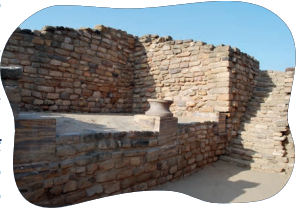
(a) What is the name of this archaeological site, and which ancient civilisation does it belong to?
(b) Why are sites like this important for understanding history?
(c) What happens to the objects discovered during excavations at such sites?
Answer:
(a) The site is Dholavira, and it belongs to the Sindhu-Sarasvati Civilisation (also known as Indus Valley Civilisation).
(b) Archaeological sites are important because they preserve evidence of ancient human societies. Archaeologists excavate these sites and analyse artefacts and remains that are uncovered, which helps us understand the kind of societies that existed many centuries ago.
(c) The objects discovered during excavation are carefully preserved and usually kept in a museum located near the site, where people can see them and learn about the ancient civilisation.
Question 22.
Look at the image given below and answer the questions that follow.

(a) Is this object considered an artefact? Why or why not?
(b) How might the story behind this object be interesting for a school museum?
(c) How is this old iron different from the irons we use today?
Answer:
(a) Yes, this object is considered an artefact because it is an old object made by humans that shows how people lived and what technology they used in the 1950s. It is unique and related to our cultural history.
(b) The story could be interesting because it shows how household technology has changed over time. Students could research who used such irons, how they were different from modern irons and maybe find a family story about the first electric iron in a neighbourhood.
(c) This old iron is different from the irons we use today because it is heavier, has a simpler design, takes longer to heat and lacks modern safety features like automatic shut-off. In contrast, modern irons are lighter, heat faster and include steam functions and temperature controls, making them more convenient and safer to use.
Question 23.
Complete the following flow chart related to Archaeological Evidence.

Answer:
(a) Archaeological sites
(a) Shilalekh (inscriptions)
Question 24.
Complete the following flow chart related to Museum Classification.

Answer:
(a) Science Centres/Museums
(b) Open-air museum
Question 25.
Create a concept map showing the main elements of a School Museum Project.
Answer:

Question 26.
Make a concept map showing different methods of presenting artefacts in an exhibition.
Answer:

Question 27.
Assume the role of a Museum Curator. Explain and demonstrate how to collect, preserve, label, and display artefacts for a school museum. Also describe how AI tools can be used to identify artefacts, read old documents, and present their history to visitors.
Answer:
Do it yourself
Question 28.
Discuss the importance of museums in preserving history, culture, and traditions. Also share how modern technologies and Al tools can help in documenting, identifying, and presenting artefacts more effectively.
Answer:
Do it yourself
School Museum Class 6 MCQ
Question 1.
Riya’s grandmother gave her an old copper vessel that has been in the family for over 100 years. This copper vessel can be best described as
(a) an antique decorative piece.
(b) an artefact with historical significance.
(c) a modern utility item.
(d) a waste material.
Answer:
(b) an artefact with historical significance.
Question 2.
During your school museum project, you need to understand the role of a person who selects and looks after artefacts in a museum. This person is called a
(a) historian
(b) archaeologist
(c) curator
(d) tour guide
Answer:
(c) curator
Question 3.
While visiting the National Science Centre in Delhi, you come across a heavy stone ball that spins on water. What is special about this exhibit?
(a) It is made of iron and floats.
(b) It weighs 1200 kg and is made of granite, yet spins on water.
(c) It is a modern invention made of plastic.
(d) It was brought from outer space.
Answer:
(b) It weighs 1200 kg and is made of granite, yet spins on water.
Question 4.
Your friend shows you an old stone slab with carved writing from an ancient temple. This carved writing on stone is called
(a) manuscript
(b) painting
(c) shilalekh
(d) photograph
Answer:
(c) shilalekh
Question 5.
If you want to read an old, faded document written in a language you don’t understand, which Al tool would be most helpful?
(a) Calculator
(b) Google Lens with translation feature
(c) Camera flash
(d) Printer
Answer:
(b) Google Lens with translation feature
Question 6.
At the Tribal Museum in Bhopal, you see displays showing the traditional art and craft of various tribes. This type of museum helps us understand
(a) only modern technology.
(b) the culture and traditions of different communities.
(c) future scientific inventions.
(d) only ancient kings and queens.
Answer:
(b) the culture and traditions of different communities.
Question 7.
When handling an old photograph for your school museum, which practice is correct?
(a) Fold it to fit in a small envelope.
(b) Touch the surface with oily fingers.
(c) Keep it flat in a clean envelope and handle by the edges only.
(d) Paste it on the wall with glue.
Answer:
(c) Keep it flat in a clean envelope and handle by the edges only.
Question 8.
Archaeologists carefully dig at sites like Dholavira to find artefacts. What is this process called?
(a) Construction
(b) Excavation
(c) Painting
(d) Cleaning
Answer:
(b) Excavation
Question 9.
Your grandmother tells you a story about how her grandmother used a particular artefact. This spoken story passed down through generations is called
(a) written history
(b) oral history
(c) fiction story
(d) textbook knowledge
Answer:
(b) oral history
Question 10.
Which of the following would be the least suitable artefact for a school museum exhibition?
(a) A 50-year-old radio.
(b) A broken plastic bottle from last week.
(c) Old brass bells from a temple.
(d) A handmade fan (Pankha) from before electricity.
Answer:
(b) A broken plastic bottle from last week.
Question 11.
You want to create a presentation about an artefact for visitors who speak different Indian languages. Which tool would help you translate your presentation?
(a) Compass
(b) Bhashini Anuvaad
(c) Microscope
(d) Calculator
Answer:
(b) Bhashini Anuvaad
Question 12.
The Kisama Heritage Village in Nagaland is an example of
(a) an indoor science museum.
(b) an open-air museum showing traditional houses.
(c) a modern art gallery.
(d) a shopping mall.
Answer:
(b) an open-air museum showing traditional houses.
Question 13.
To preserve a brass artefact like an old lamp, you should
(a) keep it in a damp place.
(b) wash it with rough sandpaper.
(c) clean with a soft cloth, polish and store away from moisture.
(d) leave it in direct sunlight.
Answer:
(c) clean with a soft cloth, polish and store away from moisture.
Question 14.
What is the main purpose of writing labels for artefacts in a museum exhibition?
(a) To make the exhibition look colourful.
(b) To briefly describe the object and its significance to visitors.
(c) To hide information from visitors.
(d) To sell the artefacts.
Answer:
(b) To briefly describe the object and its significance to visitors.
Question 15.
After your school museum exhibition, you collect feedback from visitors. Why is this important?
(a) To throw away the artefacts.
(b) To understand what went well and what can be improved.
(c) To collect money from visitors.
(d) To close the museum permanently.
Answer:
(b) To understand what went well and what can be improved.
Fill In the Blanks
1. A ____________ is a place where artefacts are kept and displayed to help people understand history and culture.
Answer:
museum
2. The ancient site of ____________ is an important archaeological site of the Sindhu-Sarasvati Civilisation located in Gujarat.
Answer:
Dholavira
3. Optical Character Recognition is abbreviated as ____________ and helps read text from images.
Answer:
OCR
4. Before electricity reached all homes, people used a handmade fan called ____________ made of recycled wool and cloth.
Answer:
Pankha
5. The AI tool that helps translate spoken words from one Indian language to another is called ____________
Answer:
Bhashini Anuvaad
6. A ____________ is a written or engraved text carved on stone, cave walls or buildings.
Answer:
shilalekh / inscription
True or False
1. Museums only display objects from ancient times and have no connection to present-day culture.
Answer:
False
2. A wooden artefact should be dusted with a soft brush to keep it safe.
Answer:
True
3. Google Lens can only be used for taking selfies and cannot help with reading old documents.
Answer:
False
4. When visiting a museum, you should touch all artefacts with bare hands to feel their texture.
Answer:
False
5. A curator is responsible for selecting and caring for artefacts in a museum.
Answer:
True
6. Photographs do not need any special care because they are just paper.
Answer:
False
The post Kaushal Bodh Class 6 Chapter 5 Extra Questions MCQ School Museum appeared first on Learn CBSE.
from Learn CBSE https://ift.tt/oRncj3X
via IFTTT

No comments:
Post a Comment